


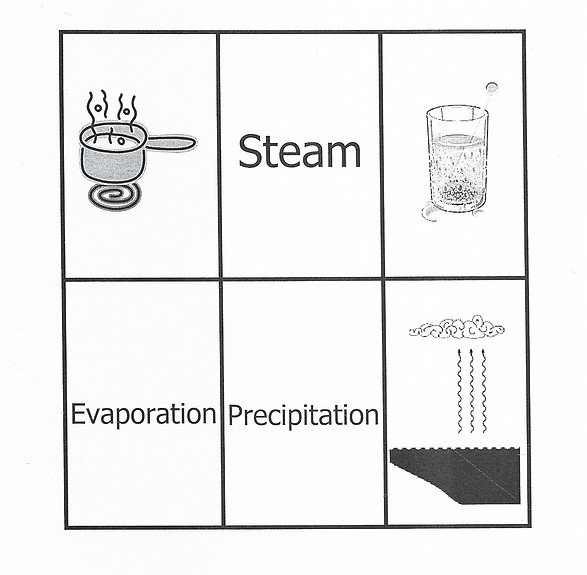


Together with my team, we planned a five-week unit lesson plan, teaching second graders Air and Weather. My second graders LOVE Science and are very engaged when it is time for Science! I've created a sort of gallery below, snapshots of certain days within the instructional plan, the various activities, and both conventional and unconventional ways that I assessed and they self-assesed their mastery of the main ideas.
On Day One, I pointed out the Weather Graph that I had already taped to each of their desks. I wrote a graphic organizer on the board and asked them how they would describe weather and what causes changes in weather? We talked about their ideas and what weather actually is and I introduced several vocabulary words: weather, temperature, and meteorologist. I have a Word Wall for Science and after I teach the the meaning, I write that word on an index card and post it on the Word Wall. I assigned my first meteorologist and told them that I would rotate that job every week. Because this was a five-week lesson plan, I told them that the meteorologist would record the temperature high in both celsius and fahrenheit everyday on the white board and we would copy it onto our graph taped in the upper right hand corner of our desk. During Week One we also watched a Brain Pop Jr on temperature, which lead into Week Two.
Week One
I made a fun anchor chart and as a whole group we did a mirror exercise four times in a row (I model and they echo my prompt). Then they copied the poem into their Science journals and recited it to their elbow partners several times. I went around and asked everyone to recite it from memory (I told them they could peek at their journal if they needed to, but of course, they didn't want to). I explained to them that a majority of the world records and understands the weather in celsius and that’s why we were teaching them celsius in addition to fahrenheit.
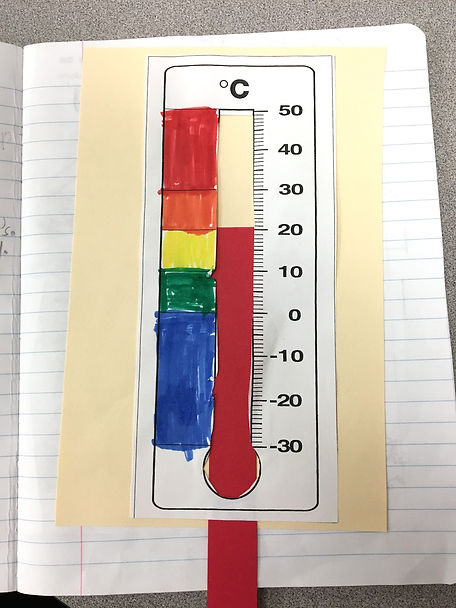
Another thing I do as a practice of issuing rewards, is reserve the slightly more entertaining learning activity as an incentive for demonstrating mastery (or simply completion of the less entertaining exercise). For example, I kept a stack of the thermometer craft in my hands and when the student recited the poem to me, I smiled, gave a quick verbal affirmation, and handed them their reward (the thermometers).
Technology Used: Brain Pop Jr. Brain Pop gives an entertaining lesson in an animated video form. Brain Pop has distilled down the content of the topic you're teaching (i.e. temperature) into it's most essential pieces (amount of heat, amount of cold present, etc) in a fun cartoon video (so good that it totally holds my attention too!). And at the end it allows you to give their animated quiz, we always do this as a whole group activity and my kids LOVE it!!!!! I have them write A,B,C,D on separate index cards (which they keep in their desk) and I have everyone hold up their answer at the same time (after I count to three) and then we check our answers on the big screen within the Brain Pop Jr. quiz. It gives us our score at the end. They get such a kick out of this.
Week Two
As a warm-up to transition from Specials back into the classroom for Science, I have a Quiz on the board, usually two questions based on the previous Science lesson (one very easy question and one Higher Order Thinking question). I give everyone five minutes and then have them hold up their journals and let me peek at their answers (I also power-walk during the quiz and read some of their answers as I walk around). This is how I assess their mastery of what we learned the previous day. The daily quiz is my data piece, it helps me measure their degree of mastery and identify which areas of content I need to intensify. In looking at the quiz answers, I also decide right then if I need to re-teach a few things (or sometimes even re-teach a key concept if a majority are not getting the main idea) or move on to what’s on today’s lesson plan. If I do a lot of re-teaching, I adjust the lesson plan for the remainder of the week or the unit (and try and stack a few concepts in effort to catch back up to the lesson cycle).
I also try and engage my different learning styles: Kinesthetic, Visual, Auditory, Verbal, and Solitary. Hopefully you see that reflected in the activities and independent work within this lesson cycle on Air and Weather.
Technology Used: Walter the Waterdrop, YouTube
Week Three and Week Four

Cumulus Clouds
(photo courtesy of Deborah J. Stewart M.Ed)


A sample of how
I make it happen
in the classroom
in other words,
how I lesson plan
Me and My Little Studs Singing
The Water Cycle Song
The Water Cycle Song Cups Style
(super fun! However, I cut the video off at 1:25 instead of watching the Bloopers)

Week Five - REVIEW TIME!
Crafts can be a great Review Tool
I'm learning more about Whole Brain Teaching
and I LOVE how this third grade teacher reviewed
The Water Cycle using Whole Brain Techniques
Guided Practice, Games are a great way for students to review and I can walk around and check for understanding
